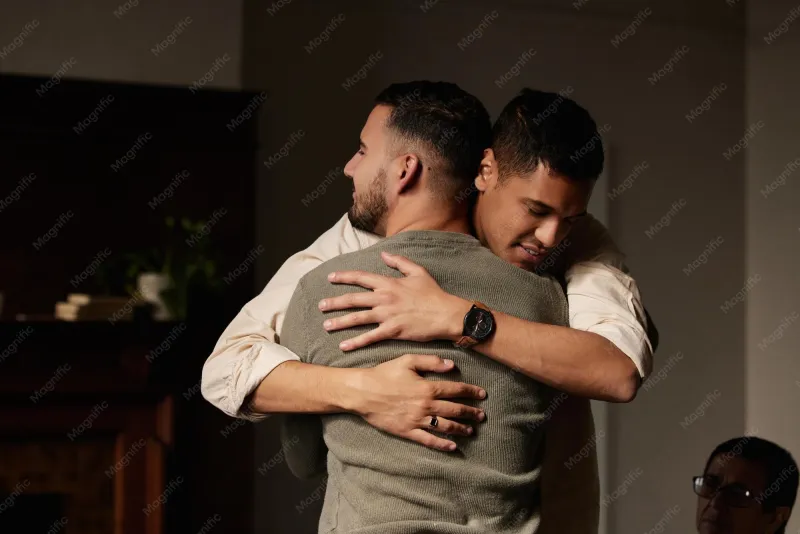
Sorry Isn't the Hard Part: What Real Repair Looks Like Between Brothers
Photo: Rembrandt, PDM-owner, via Wikimedia Commons
Two words can kill a friendship faster than an insult: my bad.
Not because the words are wrong. Because they're usually a stand-in for something the guy never actually says. He says my bad and means let's move on. He says it fast, before his buddy can respond, so the whole thing stays at surface level where it's survivable. And his buddy nods, and they go back to watching the game, and the thing sits there — unaddressed, unhealed, quietly accumulating.
Six months later somebody's not answering texts and neither of them can explain why.
Why So Many Apologies Between Men Flop
Three reasons, and they show up over and over.
They're vague. No specifics, no ownership of the actual harm. Real repair requires naming what happened in plain language, which means saying the thing out loud that you'd rather skip past.
They're defensive. The apology gets packaged with a justification, so it lands like a legal filing. I'm sorry, but you have to understand, the way you said it made me— That's not repair. That's a counterargument wearing a nice shirt.
They're late. Not hours late. Weeks late, or never, with the assumption that time does the work. Time doesn't do the work. Time just makes the conversation more expensive, because now your buddy has had months to build a story about who you are.
The good news: none of this requires a big emotional performance. Most men are bad at speeches and good at follow-through. Repair leans on the second one.
Name the Harm, Not the Vibe
The opening move is specificity. Not, I know things have been weird. Try: I said what you told me in confidence to the whole group. That's what I did. That's the harm.
Notice what that sentence doesn't have. No vibes, no feelings-word salad, no hedging. It's a clean statement of fact that proves you understand the thing you broke. If you can't state the harm in one sentence, you're not ready to apologize yet — you're still negotiating with yourself about how much to admit.
And name the effect too. Not just what you did, but what it cost him. Trust, access to his privacy, his ability to tell you hard things next time. A man who hears you describe the damage accurately knows he doesn't have to explain it to you. That's half the repair right there.
Cut the Courtroom Defense
Here's the line in the sand: an apology with a because is a defense, not an apology.
I'm sorry, but you know how I get when I've had a few. I'm sorry, but you were being a jerk too. I'm sorry, but honestly I thought you'd be fine with it. Every one of those is really about protecting your own standing. And your brother can hear it instantly, because he's heard it before from other people.
There's a place for context — later, in a different conversation, once trust is rebuilt. If your buddy asks what happened in your head, then you can walk him through it. You don't volunteer it during the apology. The apology is the one moment you're not the main character.
Behavior Is the Receipt
The words get you into the room. Behavior is what keeps you there.
This is where most repair jobs fall apart, because the change part takes months and nobody's watching the way they were watching during the apology. If the harm was that you talk about his stuff to other people, then the proof is that he never hears a rumor that started with you, for a year, starting now. If the harm was that you disappear when things get hard, then the proof is you showing up to the boring stuff — the move, the hospital visit, the Tuesday when he's just flat.
A quiet, useful rule: don't announce your growth. Just let the next 12 months do the talking. Men generally trust patterns over promises anyway.
Space Isn't a Punishment
One of the hardest parts of repair for guys is accepting that forgiveness isn't on your timeline. You said the thing, you owned it, you feel terrible — and now you want it resolved by Thursday.
That's not repair. That's pressure.
If your brother needs distance, give it without a running commentary. Don't text every three days asking if you're good. Don't send the oblique meme that's really a check-in. Offer the space cleanly: you don't have to respond to this, take what you need. Then actually take the hint.
The move that helps: open the door once and leave it open. I'm here when you want to talk. And then let him walk through it on his schedule. Men often need to cool off before they can be honest, and pushing for instant absolution just adds a second injury on top of the first.
What Forgiveness Actually Means Here
Some guys hear forgiveness and picture everything snapping back to how it was. That's not always on offer, and pretending otherwise creates bad faith on both sides. What you're actually working toward is a little more modest and a lot more real: a relationship that can hold the truth of what happened without it being the only thing in the room.
That might mean a slower rebuild. It might mean the friendship gets smaller and sturdier. It might mean you never quite get the easy version back, but you get a version that doesn't flinch.
Repair is unglamorous work. It's one specific sentence, zero excuses, and then a long stretch of just quietly being the guy who doesn't do that anymore. That's not a speech. That's a brotherhood worth having.